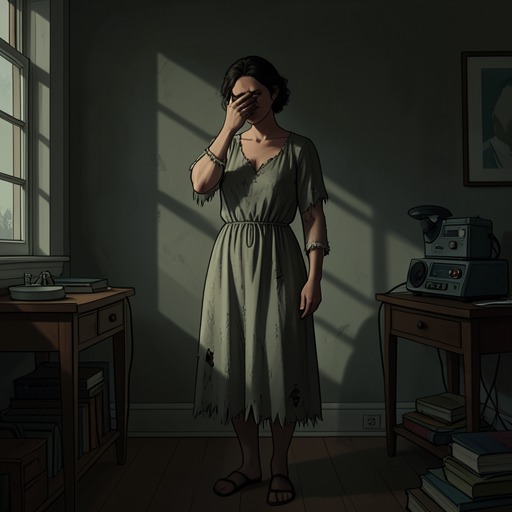
Constance Blackwood’s self-imposed confinement
We Have Always Lived in the CastleConstance Blackwood’s self-imposed confinement is both a settled pattern of life and a boundary she begins, cautiously, to imagine crossing. She remains within her garden while Mary Katherine Blackwood makes the necessary trips into the village, and her home-centered routine offers security against a world Mary Katherine describes as hostile. Yet after Helen Clarke urges her to rejoin that world, Constance listens rather than simply retreating: she watches the driveway, considers the gates, and acknowledges that sooner or later she will have to take a first step. Her seclusion is therefore presented not as an unchanging condition, but as a shelter under pressure from an uncertain desire to move beyond it.
Identity and Domestic Boundaries
Constance’s confinement is defined through ordinary limits rather than an explicit declaration that she will never leave. Mary Katherine says that Constance never goes past her own garden; the distinction is especially clear because Mary Katherine herself goes into the village twice a week for books and groceries. These trips are not presented as social freedom: they are necessary errands, and Mary Katherine also stops at Stella’s for coffee partly because she cannot bear the thought that Stella might think she is afraid. Constance, by contrast, remains at home, where the garden and domestic work shape the extent of her daily world.
The household’s attachment to permanence gives that boundary a material setting. The Blackwoods rarely move things: possessions are put back in their places, and generations of family belongings have accumulated in the house like layers, giving it stability against the outside world. When Constance places the library books on the shelf, Mary Katherine imagines them staying there forever. This image connects confinement to a broader domestic order built on continuity and familiarity. The home protects not only by keeping Constance within it, but by making the settled arrangement of objects and routines feel enduring.
A First Step Toward the Outside
Constance’s first stated possibility of leaving comes as a brief, startling admission to Mary Katherine: “Someday I’ll go.” Mary Katherine notes that this is the second time Constance has spoken of going outside and reacts with alarm. The remark does not specify where Constance might go or when she would do so. Its importance lies in the fact that departure has entered her speech at all: a boundary that had seemed fixed is now something she can picture crossing.
Helen Clarke’s visit gives that possibility a social context. Helen tells Constance that she is young and lovely, has a right to be happy, and should “Come back into the world.” Mary Katherine anticipates the advice and wants Constance to avoid hearing it. But Constance listens and smiles, even as she shakes her head. Her response differs from the retreat Helen’s words would have prompted only a month earlier. She does not accept the invitation outright; instead, she tells Mary Katherine that she thinks it will be all right and insists, “You watch me.” When Mary Katherine offers to send the visitors away, Constance refuses that protection, explaining that sooner or later she will have to take a first step.
The Garden, Driveway, and Gates
After Helen’s tea, Constance’s attention begins to reach beyond the immediate work of the garden and the house. Mary Katherine watches her stand among the plants and look outward toward the trees hiding the fence, rather than down at the plants or back at the house. At other moments Constance studies the length of the driveway, as if wondering what it would feel like to walk along it to the gates. On the Saturday after Helen’s visit, she looks down the driveway three times. The repeated glances do not amount to a departure, but they give her changed attitude a visible form: the route out has become an object of sustained attention.
This movement outward occurs amid a household still organized around care and familiar routines. When Constance’s uncle, Julian Blackwood, is unwell after the tea, he stays in his room beside the kitchen and calls for her attention; Constance is waiting to make Mary Katherine breakfast. The details keep the possibility of change close to domestic obligations rather than separating it from them. Constance’s world remains one in which she tends the garden and cares for those at home, even as her gaze turns toward the route leading beyond the fence.
Attachment, Fear, and Unresolved Change
Mary Katherine experiences Constance’s possible departure as a threat to their shared security. She is chilled by the first mention of going outside, wants to shield Constance from Helen’s advice, and says she will send the visitors away. Later, when Constance asks whether she ever wants to leave, Mary Katherine answers with questions about where they could go and who would want them, concluding that the world is full of terrible people. The exchange makes their attachment to the home explicit, but it also shows that they do not speak from precisely the same position: Constance wonders aloud about leaving, while Mary Katherine argues for staying.
Constance offers reassurance that nothing bad will happen, yet her seriousness before she smiles leaves her curiosity intact rather than resolving it. The evidence does not show her actually walking to the gates or abandoning her home. Instead, her confinement reaches a threshold: she has entertained departure, received an invitation to reenter the social world, and begun to look toward the way out. The tension between protection and possibility gives the state its significance. The garden remains Constance’s established boundary, but it is no longer the only future she can imagine.